
Celebrating the Symba Scooter
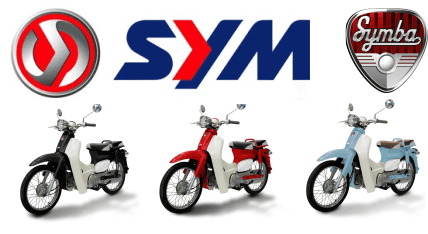
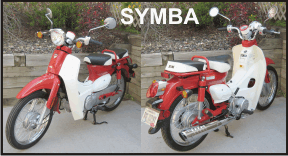
The SYMBA has evolved through decades of Taiwanese engineering yet remains true to its original CLASSIC DESIGN

May 2010 – SYM has lowered the MSRP on the Symba from $2,598 to $2,399

 Symba Accessories
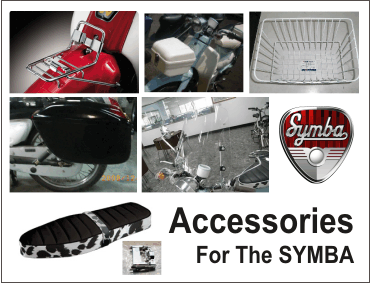
There are MANY accessories available for the Symba including luggage options, a windscreen, and a potentially important seating option.
While reviewing the Symba, I only encountered one concern – for some people the stock dual seating with a large metal grab-rail between the seats is going to be a problem. If you are a taller-than-average person or a larger-than-average person, you will likely want to sit further back on the bike than the stock front seat allows. This can result in your (ahem) hindquarters hitting right up against the metal bar between the seats. Being one of those “larger” type people myself, this resulted in rather an uncomfortable bruise after a fair amount of riding. You’ll notice in the lower/left picture above that a full bench seat is available for the Symba.
Carter Brothers (the USA importer/distributor of SYM) has also produced an optional configuration which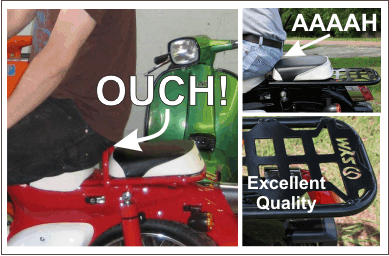 includes a VERY nice quality rear luggage rack along with removal of the offending metal bar between the seats.
As you will see in the review below, I think the Symba is a wonderful scooter once you get the seating configuration that best suits your build.
The classic design on which the Symba is based represents the world’s most popular motor vehicle. That’s right, more units sold than the VW Beetle, or Ford F-150, or ANY other motor vehicle. The Symba brings to the US market a GREAT do-everything form of two-wheeled transportation that has proven itself in daily use all over the globe. If you don’t believe me, have a look at Bikes of Burden by Hans Kemp (available at AMAZON). I strongly suggest that you visit your local SYM Dealer and check out the Symba.
Review of the SYM Symba
June 2009
May 2010 – SYM has lowered the MSRP on the Symba from $2,598 to $2,399
I like the Stella by Genuine Scooters. In fact, I liked it so much that I bought one (about five years ago). I was one of those people who had a P-series Vespa back in my school days because it was cheap and (relatively) easy to keep running. These days there are several scooters in my garage and yet the Stella continues to be a favourite that I ride often. Why am I talking about a Stella in a review of the Symba? Because it is the kind of modern machine that has the same sort of “draw” for me that the Stella had.
In the 1970s, a P-series Vespa was a pretty cool machine – inexpensive, decent performance, good fuel economy. Of course there were things about it that limited it’s capabilities, but it did quite well with the technology available. You know what else I owned way back when (the very early 1980s)? A Honda Passport. The C70 Cub was introduced in the US in 1970. It was later called the Passport and was sold here until 1984. The Honda Cub is the most popular motor vehicle in the world. As of May of 2008, 60 Million have been built. 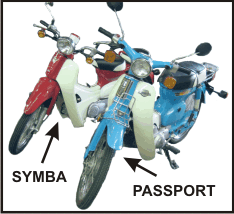
I remember my Passport quite fondly. I wasn’t really a scooter or a motorcycle (in my mind) but something of both. It has big wheels which add to the stability and ride quality as compared to the small wheels of my Vespa. It has a shifter, but no clutch lever (the clutch is automatic). It has a partial “step-through” design. It was as durable and reliable as all get-out. So you see, just like the Stella brings back fond memories of my Vespa (with much improved technology), the Symba gives me that same silly grin that my old Passport did… and it’s new! Oh yeah, it’s also built by a top-line Taiwanese company known for quality.
The Symba has been available in other countries (as the Wowow) for some time and its arrival on these shores has been anxiously anticipated for a while now. The Symba used for this review was generously provided by BlueCat Motors in St. Paul, Minnesota. Overall, I was very happy with the Symba with one exception which I will cover in a bit. I will also say that this issue has been addressed by Carter Brothers (the importer and distributor in the US).
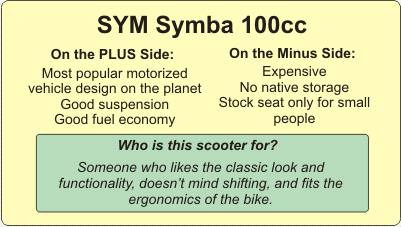 Speedometer Reading/Speed/Fuel Economy
As is the case with the vast majority of scooters we test, the speedometer was optimistic on the Symba. It indicates about 10% faster than the actual speed. The odometer is similarly optimistic. I verified the speedometer with a GPS unit and the odometer on a measured mile of roadway. When the speedometer indicates 30 MPH, the actual speed is 27 MPH. The numbers for fuel economy and top speed have been adjusted to compensate and are given in “actual” numbers. The Symba used for this review was new, so these numbers are likely to improve after engine break-in. I got the Symba to a top speed of 48 MPH. This was with a 220 pound rider. With a 160 pound rider, after about 100 miles were on the bike, the top speed was 52 MPH. My best guess is that after 300 – 500 miles of break-in and with a 150 – 175 pound rider, the top end is going to be in the low 50s. Overall fuel economy during the review was 91 MPG. I consider this to be outstanding. Remember, most of the riding was with a heavy rider and I was pushing the bike fairly hard. After break-in with “normal” riding in the 30MPH – 45 MPH range, I would expect close to 100 MPG.
Features
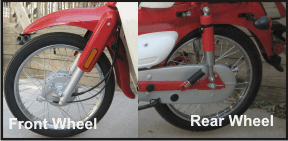
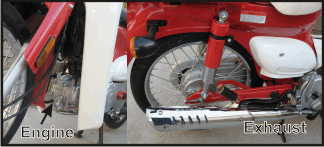
Sorry, no comparison chart for this review. I can’t think of any other bike currently offered in the US market to compare the Symba to. The Symba has a MSRP of $2,598 and carries a two-year warranty. The Symba is powered by a 101cc four-stroke engine with forced air cooling. It is fed combustible mixture through a carburetor and makes nearly 7 horsepower. Power is transferred to the rear wheel by means of a chain which is covered.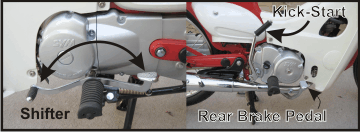 There is a four-speed transmission with an automatically actuating clutch. There’s a shifter by the left foot, but no lever for the left hand. This arrangement takes some getting used to, especially if you are coming off of a conventional motorcycle. Once a person gets the hang of the heel/toe shifter, it’s very easy and even starts to feel “natural” quickly. The spoked 17 inch wheels carry inner-tube style 2.50-17-38L ties. Drum brakes are utilized front and rear. The front suspension is a telescoping fork. Yes, let me say that again for all of you Cub/Passport fans out there…. a real telescoping fork. This is probably one of the biggest improvements over the traditional Cub design. The rear rides on adjustable shocks (another improvement). The Symba has a seat height of 30 inches and weighs 209 pounds. The listed carrying capacity is 199 pounds, so I guess (technically) I was more than the bike could handle.
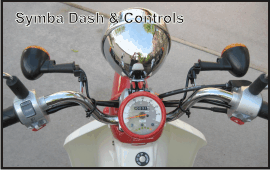 The Symba has an integrated switch in the center of the bike. Turn it clockwise to the “on” position to run the bike and anti-clockwise to lock the front end toward the left. The display is contained in a single round module that houses the speedometer & odometer which are biased to miles. There are three small indicator lights for high beam, neutral & turn signals. Just below those three lights is a curved row of five small lights that act as a fuel gauge. The electric starter button is on the right-hand control along with the “engine kill” switch. The front brake lever is also on the right as is the throttle. On the left-hand control “high-beam/low-beam” headlight switch, push-to-cancel turn signals, and the horn switch. There is no brake or clutch lever on the left. The rear brake pedal is located on the right side of the Symba along with the kick-starter. The heel/toe shifter is on the left side. Under the front seat you will find a locking fuel cap and just to the side
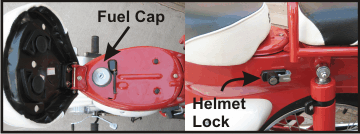 between the seats a helmet lock. There is no “native” storage to speak of on the Symba. However, front racks, rear racks, trunks, saddlebags and so forth are readily available.
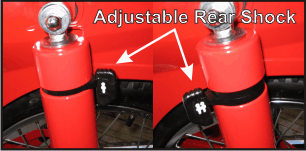
The adjustable rear shocks worked well. There is a “one person” or “two person” symbol on the adjusters and I noticed the ride was much better on the “two person” setting. Then again, according to the Symba carrying capacity, I AM two persons. The front turn indicators look a little like an after-thought, but so do about 90% of the front indicators on scooters in the US. UNLIKE the Cub/Passport, the Symba has a naked bar as opposed to an enclosed headset. Which look you prefer is strictly a matter of personal preference. The gas tank under the front seat is small, holding just about one gallon. Not a big deal as you still won’t need to fill it up all that often.
Riding Impressions
The Symba started easily ran great throughout our review. The kick-starter worked well, though I never HAD TO use it as the electric was quite reliable (another improvement over the Passport). My ONE complaint has to do with the ergonomics of the Symba. The small front seat and passenger pillion with the large tubular metal grab-rail in between them made it impossible for me to find a comfortable riding position. It also made it difficult for me to correctly position my foot to operate the heel/toe shifter. After 100 miles of riding I had a large bruise above my tailbone because I was virtually sitting on the metal bar. Whether or not this is an issue for you will depend on your size.
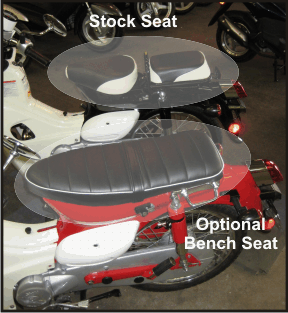 A short time after I completed this review, Carter Brothers sent one of the new optional bench seats out to BlueCat Motors. Of course I rushed right over to try it out. For me, it’s like a whole new bike! I was able to sit comfortably in the position that allowed my foot to be perfectly placed on the heel/toe shifter. With the stock seat configuration, the metal grab-rail was in the way. With the addition of this optional seat, Carter Brothers has given the consumer a way to select the configuration that will best suit them.
Operating the semi-manual transmission is a breeze. At first I thought the gearing was a bit too tall, but after I got used to it, the spacing of the shift points seemed just right. The large 17 inch wheels and excellent suspension give the Symba a secure and smooth ride. The drum breaks may be kind of “old school” but they worked just fine with no noticeable fade. On a bike of this size in typical urban riding conditions I believe they are perfectly adequate. The Symba is no speed demon. It accelerates smoothly though not briskly – just like my old Passport did. I had no difficulty in keeping up with city traffic. The headlight works well. That may not sound like such a big deal, but those of you who had old Passports will remember the holding-a-candle-in-front-of-you feel of those bikes when riding at night.
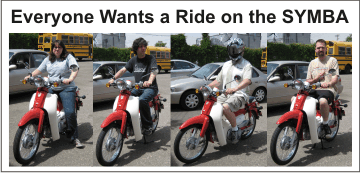 Everybody wanted to ride the Symba. Even other non-SYM dealers wanted to have a spin. Bob Hedstrom of Scooterville enjoyed the bike and commented that the Symba should be the bike to stop people from riding with sandals on their feet! (could be painful with that shifter) Other than the correctable seating issue, I thought the Symba was a blast to ride.
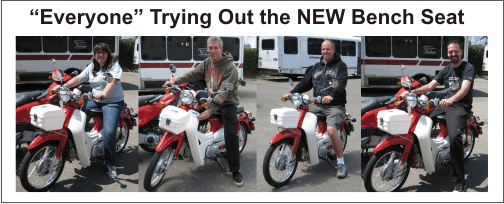 After the optional bench seat arrived, I asked several people to try the Symba again. Lora (the young lady pictured to the left in the above image) is on the short side and the stock seat fit her better. Everyone else was much happier with the bench seat. It seems that from 5′ 9″ on up, the stock seat forces a sitting position that is too far forward on the bike for most people. Again, I was amazed at how much improvement there was for me in ease of shifter use with the bench seat. When you go to check out the Symba (something you really should do) ask your dealer to install a bench seat for you to try if you are at all uncomfortable with the stock configuration.
Fit & Finish
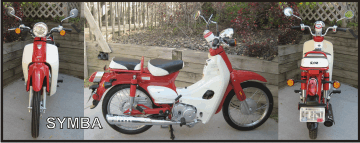
 Honda is no slouch when it comes to fit and finish. The Cub/Passport has always been representative of Honda’s commitment to quality. That being said, I think the Symba is a notch up. The paint-work has that wonderful “deep” look and even the plastic parts just seem more substantial than what is found on any other brand. This should come as no surprise to those who are experienced with SYM’s other fine product offerings. The shiny bits are nicely chromed. Nothing on the Symba looks “cheap” and the quality of manufacture is evident in the close tolerances and well-engineered components.
Conclusions
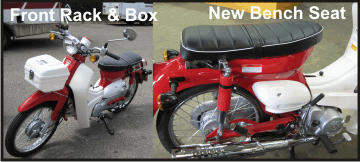 Several people who were looking forward to the Symba thought the $2,600 MSRP was a little high. After riding it and seeing the quality first-hand, they didn’t seem to be as worried about the price. There are enough options from Carter Brothers on the Symba to cover most ergonomic needs of most riders. Be sure you get the correct seating configuration for your physique and you’ll be happy on the Symba. The price of the accessories from Carter Brothers is very reasonable. The bench seat pictured above is $179. That’s a very fair price for a complete seat assembly. This seat includes outstanding mounting brackets and a positive latching system. The front rack is just $39 and you have a choice of an open-top basket or a small plastic locking box for the front, also just $39 each. For most any urban (non-highway) application the Symba’s performance is just fine.
There’s a reason that the classic design of the Symba represents the most popular motor vehicle in the world – it works well and is highly adaptable. If you want to revive memories of your youth on a Cub or Passport, get a Symba. If you want practical urban transportation with great fuel economy and low operating cost, get a Symba. If you want both and a bunch of fun, get a Symba.
May 2010 – SYM has lowered the MSRP on the Symba from $2,598 to $2,399